
Trolling Motor Battery: What Size, How Many, How Long
What size trolling motor battery you need, how many for 12, 24 or 36 volts, and how long it lasts, worked out from Minn Kota's published amp draw figures.
System Planner
Boat weight, conditions and hours in: thrust, voltage, battery bank, runtime, wire gauge, breaker and charger out.
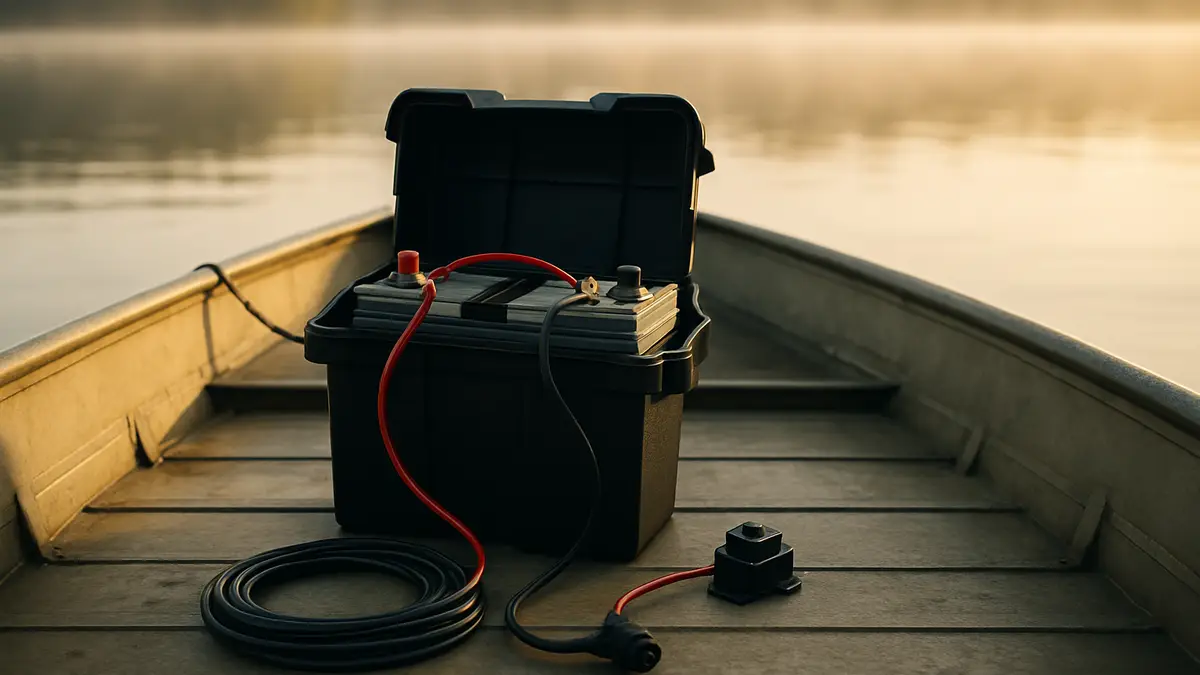
A trolling motor battery is a 12-volt deep-cycle battery built to be drained slowly and recharged hundreds of times, unlike a starting battery that delivers one short burst. Picking one comes down to three numbers: the amp-hours (Ah) on the label, how many batteries your motor’s voltage needs, and how many hours of running you expect in a day. This page works all three out from Minn Kota’s own published figures.
What size battery do you need for a trolling motor?
A 12-volt deep-cycle marine battery rated at least 110 Ah is Minn Kota’s recommendation. Its Battery & Wiring Installation sheet (Rev. 8.17.2021) says any 12 V lead-acid deep-cycle marine battery will run its motors and grades the common sizes by run time:
| Minn Kota grade | BCI group size | Amp-hours (12 V) |
|---|---|---|
| Good | Group 24 | 70-85 Ah |
| Better | Group 27 | 85-110 Ah |
| Best | Group 31 | 95-125 Ah |
Group size is a case size, not a capacity, so always read the Ah figure on the label. Garmin sets a similar floor for its Force motors: 100 Ah minimum for lead-acid or AGM, 50 to 100 Ah for lithium, and a battery able to supply at least 60 A continuously. For the differences between starting, deep-cycle and dual-purpose batteries, see marine battery types explained.
How many batteries does a trolling motor need?
One battery per 12 volts of motor voltage. A 12 V motor runs on one battery, a 24 V motor on two wired in series, and a 36 V motor on three in series. In the Minn Kota lineup, 12 V covers motors up to 55 lb of thrust, 24 V covers 70 to 80 lb, and 36 V covers 101 to 112 lb.
Every battery in a series bank must be the same make, type, size and age, and the jumper between batteries should be one wire size larger than the motor lead, per the same Minn Kota sheet. Mixing an old battery with a new one drags the whole bank down to the weaker one.
You can also add capacity at the same voltage by wiring identical batteries in parallel: two 100 Ah batteries in parallel make a 12 V bank of 200 Ah. Our guide to 12, 24 and 36 volt trolling motors covers when to step up in voltage.
How long will a trolling motor battery last?
At half throttle, one 100 Ah AGM battery runs a 55 lb motor for about 2.5 hours; at full throttle, under an hour. Runtime falls fast with speed because current rises steeply with thrust.
The table below uses Minn Kota’s published max amp draw for each thrust class (30 lb 30 A, 45 lb 42 A, 55 lb 50 A, 80 lb 56 A, 112 lb 52 A) and 100 Ah batteries. AGM is used down to 50% to protect its cycle life; LiFePO4 down to 80%.
| Motor (bank) | 25% throttle | 50% throttle | 75% throttle | 100% throttle |
|---|---|---|---|---|
| 30 lb, 12 V (1 battery) | 13.3 h / 21.3 h | 4.4 h / 7.3 h | 2.2 h / 3.8 h | 1.4 h / 2.4 h |
| 45 lb, 12 V (1 battery) | 9.5 h / 15.2 h | 3.0 h / 5.1 h | 1.5 h / 2.7 h | 1.0 h / 1.7 h |
| 55 lb, 12 V (1 battery) | 7.8 h / 12.7 h | 2.5 h / 4.2 h | 1.3 h / 2.2 h | 0.8 h / 1.4 h |
| 80 lb, 24 V (2 batteries) | 6.9 h / 11.2 h | 2.2 h / 3.8 h | 1.1 h / 2.0 h | 0.7 h / 1.3 h |
| 112 lb, 36 V (3 batteries) | 7.5 h / 12.1 h | 2.4 h / 4.1 h | 1.2 h / 2.2 h | 0.8 h / 1.4 h |
Each cell: AGM / LiFePO4, 100 Ah per battery. Model values, not bench tests; see the method below.
Why does half throttle more than double your runtime?
Because a variable-speed motor’s current scales with thrust to roughly the 1.5 power, so half thrust draws only about 35% of max current. That is a result of propeller theory (shaft power rises with thrust to the 1.5 power), and it is the heuristic the System Planner uses: average amps = max amps x throttle^1.5.
Two corrections then apply. First, lead-acid delivers less than its label at high current (the Peukert effect, with typical exponents of 1.2 for flooded, 1.1 for AGM and 1.05 for LiFePO4). Second, only part of the capacity is usable without shortening battery life.
Minn Kota’s sheet stresses that its max amp figures occur only intermittently and are not continuous ratings, so real full-throttle runtimes are usually a bit longer than the 100% column. Older 5-speed motors with resistor speed control draw more at low settings than this model predicts.
How many amp-hours do you need for a full day?
For a 55 lb motor at half throttle, about 190 Ah of AGM or 120 Ah of lithium covers 5 hours of running. Count motor running hours, not hours on the water; most anglers run the motor for half of the day or less.
| Motor | 5 h at 50% throttle: AGM / LiFePO4 | 8 h at 50% throttle: AGM / LiFePO4 |
|---|---|---|
| 30 lb, 12 V | 113 Ah / 70 Ah | 173 Ah / 110 Ah |
| 45 lb, 12 V | 158 Ah / 98 Ah | 242 Ah / 153 Ah |
| 55 lb, 12 V | 188 Ah / 117 Ah | 289 Ah / 183 Ah |
| 80 lb, 24 V | 211 Ah / 131 Ah | 323 Ah / 205 Ah |
| 112 lb, 36 V | 196 Ah / 121 Ah | 300 Ah / 190 Ah |
Amp-hours per battery position, 20-hour rating. For 24 V and 36 V, every battery in the bank needs this rating.
Read it this way: one group 31 AGM (95 to 125 Ah) covers a 30 lb motor for a long morning. A 55 lb motor running most of the day needs two group 31s in parallel, or one lithium battery of about 120 Ah. That gap is the core of the lithium vs AGM decision.
What battery bank does a real boat need?
A 14 ft jon boat with two anglers needs a 30 lb motor and one 100 Ah battery for a 4-hour outing; an 18 ft bass boat needs a 24 V bank of about 190 Ah per battery for a 6-hour day. Both came out of the System Planner.
| 14 ft jon boat, calm lake | 18 ft bass boat, moderate wind | |
|---|---|---|
| Hull + outboard and fuel + people + gear | 200 + 0 + 400 + 60 lb | 1,100 + 450 + 400 + 200 lb |
| Loaded weight incl. batteries | about 720 lb | about 2,280 lb |
| Minimum thrust (2 lb per 100 lb) | 14.4 lb | 45.6 lb, x1.25 for wind = 57 lb |
| Motor class | 30 lb, 12 V | 70 lb, 24 V (two batteries) |
| Running time wanted, throttle | 4 h at 50% | 6 h at 50% |
| One 100 Ah battery per position gives | 4.1 h (flooded) | 3.0 h (AGM) |
| Ah per battery needed | 99 Ah flooded | 187 Ah AGM or 117 Ah LiFePO4 |
| Wire and breaker (Minn Kota table) | 10 ft run: 10 AWG, 50 A | 15 ft run: 8 AWG, 50 A |
The thrust rule is Minn Kota’s (at least 2 lb of thrust per 100 lb of loaded boat); the 1.25 wind factor is our heuristic. For the bass boat’s 6-hour day, lithium also saves about 180 lb (two 187 Ah AGMs at roughly 243 lb against two 117 Ah LiFePO4 at roughly 63 lb, using typical weight per amp-hour). For which motor style suits each hull, see bow mount vs transom mount.
Which battery type should you buy: flooded, AGM or lithium?
AGM is the low-maintenance default, flooded is the cheapest, and LiFePO4 lithium gives about two-thirds more runtime per rated amp-hour at a third to half the weight. Prices checked in October 2026:
| Battery | Type | Weight | Price (Oct 2026) |
|---|---|---|---|
| Bass Pro Shops Power Series, group 27 | AGM dual-purpose | 65 lb | $229.99 |
| Bass Pro Shops Power Series, group 31 | AGM dual-purpose | 64.3 lb | $259.99 |
| LiTime 12V 100Ah Trolling Motor (Bluetooth) | LiFePO4, group 31 case | 22.2 lb | $302.59 sale ($379.99 list) |
| Battle Born BB10012, 100 Ah | LiFePO4, group 27/31 fit | 31 lb | $799.00 sale ($949.00 list) |
Prices are from the maker and retailer product pages on 2026-10-06 and change often. The Bass Pro listing gives weight but no Ah rating, so compare its Ah on the label before buying. Lithium needs a charger with a lithium profile and has cold-charging limits; the trade-offs are covered in lithium marine batteries vs AGM.
Should the trolling motor share a battery with anything else?
No: Minn Kota recommends a separate deep-cycle battery for the trolling motor whenever a crank battery starts your gas outboard. A day of trolling can flatten a shared battery and leave the engine unable to start.
The same logic applies to the fish finder. On a 24 V or 36 V bank, tapping 12 V off one battery drains it unevenly and unbalances the series string. A small display draws little: Garmin lists the Striker Vivid 9sv at 0.75 A typical and 1.5 A max, so 8 hours uses about 6 Ah. A small separate battery, or the cranking battery on a boat with an outboard, is the cleaner source. Each circuit needs its own fuse or breaker; see the trolling motor wiring guide for gauges and breaker sizes.
How do you make a trolling motor battery last for years?
Recharge lead-acid within 12 to 24 hours of every trip, and avoid draining it below half. Minn Kota names failure to recharge in that window as the leading cause of premature battery failure.
- Recharge promptly. An onboard charger with one bank per battery makes it automatic. Our marine battery charger guide sizes the amps per bank for an overnight refill.
- Store full. Lead-acid left partly discharged over a winter sulfates. Keep it on a maintainer.
- Keep connections tight and clean. Loose posts heat up and waste voltage.
- Disconnect when charging or stored, as Minn Kota’s sheet advises, and install batteries in a ventilated compartment.
Who is this guide not for?
This page sizes batteries for electric trolling motors on small fishing boats; it is not a design guide for house banks, inverters or AC shore power. If you are building a bank larger than three batteries, adding an inverter, or running more than 25 feet of cable from batteries to motor, Minn Kota’s own advice is to have a qualified marine technician do it, following ABYC standards.
It also does not cover kayak-specific setups in depth; see kayak trolling motors for compact batteries and mounts.
How did we calculate these numbers?
Every runtime and amp-hour figure on this page comes from the same model the System Planner runs, with inputs from Minn Kota’s Battery & Wiring Installation sheet (Rev. 8.17.2021). The sheet supplies the max amp draw per thrust class, the group size table, the 110 Ah recommendation, the series wiring rules and the 12 to 24 hour recharge rule.
Our heuristics, stated plainly: average current = max current x throttle^1.5; Peukert exponents of 1.2, 1.1 and 1.05 for flooded, AGM and LiFePO4; usable capacity of 50% for lead-acid and 80% for LiFePO4; a 1.25 wind multiplier on thrust. They are typical values, not measurements of a specific battery. We did not bench-test batteries. To run your own boat, open the System Planner and enter your weights and hours.
Frequently asked questions
Quick answers to what anglers ask us most
What size battery do I need for a trolling motor?
A 12 V deep-cycle marine battery. Minn Kota recommends at least 110 Ah, which in lead-acid means a group 27 (85-110 Ah) or group 31 (95-125 Ah). A group 24 (70-85 Ah) works for short trips with a 30 lb motor.
How long will a 100 Ah battery run a trolling motor?
About 4.4 hours on a 30 lb motor and 2.5 hours on a 55 lb motor at half throttle, for an AGM used down to 50%. A 100 Ah LiFePO4 battery used to 80% runs about 7.3 and 4.2 hours. Full throttle cuts that to roughly an hour.
How many batteries does a trolling motor need?
One for a 12 V motor (up to 55 lb thrust), two in series for 24 V (70-80 lb) and three in series for 36 V (101-112 lb). Batteries in a series bank must be the same make, type, size and age.
Can I use my boat's starting battery for the trolling motor?
Minn Kota advises against it: if a crank battery starts your outboard, run the trolling motor from a separate deep-cycle battery so a long day on the motor never leaves you unable to start the engine.
How soon should I recharge a trolling motor battery?
Within 12 to 24 hours for lead-acid. Minn Kota names failure to recharge in that window as the leading cause of premature battery failure. An onboard charger plugged in at the dock makes it automatic.