
Fish Finder for a Small Boat: How to Choose One in 2026
How to choose a fish finder for a jon boat or small boat: screen size, sonar type, GPS and maps, aluminum-hull transducer mounting, and October 2026 prices.
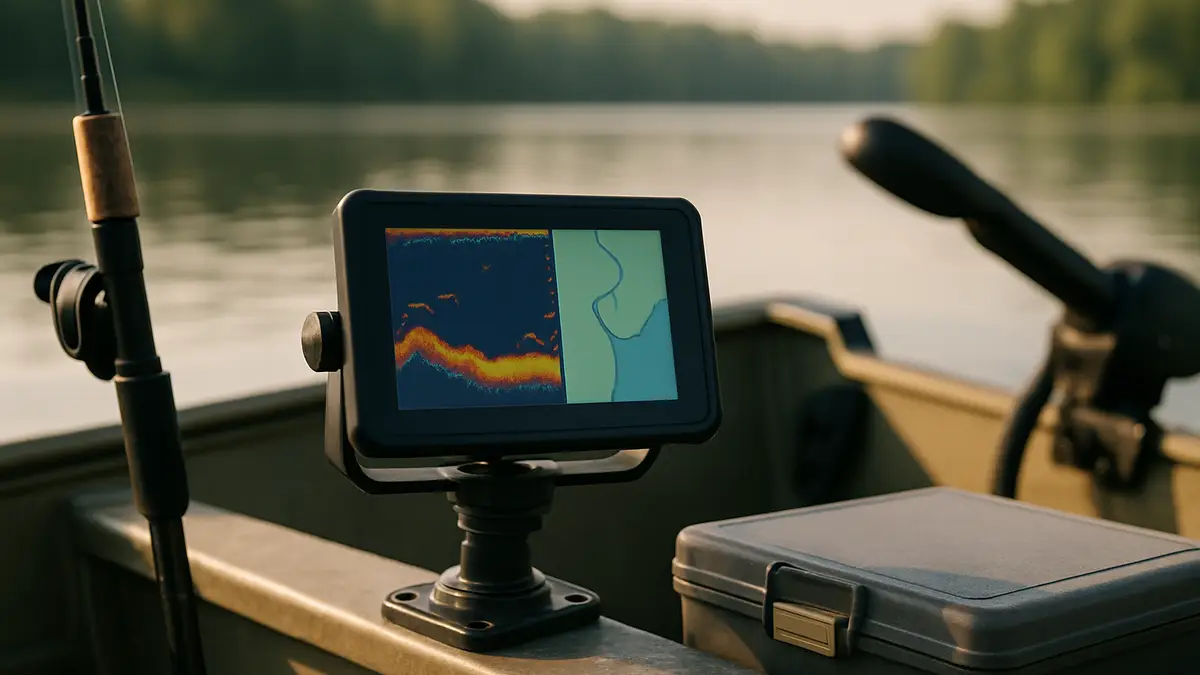
A fish finder is a sonar display: a transducer under the boat sends sound pulses into the water and the screen draws the echoes as bottom, structure and fish. For a jon boat, a small aluminum boat or a 16 ft tiller boat, the right unit is the one whose screen, sonar views and mount fit the boat, not the one with the longest feature list. Here is how to choose, with October 2026 prices.
Which fish finder should you buy for a small boat?
A 5 to 7 inch unit with CHIRP sonar, down imaging and built-in GPS covers most small boats, at about $350 to $650. That band includes the Garmin Striker Vivid 5cv and 7cv, the Humminbird Helix 5 GPS G3, and the Lowrance Eagle 5 and 7.
| Tier (Oct 2026) | Models and prices | What you get |
|---|---|---|
| Under $200 | Lowrance Eagle 4x $119.99; Garmin Striker (3.5 in) from $159.99; Garmin Striker Plus 4 $179.99; Garmin Striker Vivid 4cv $199.99 | 2D CHIRP on a small screen; Striker models add GPS, the Vivid 4cv adds ClearVü down imaging |
| $250-$450 | Humminbird Helix 5 G2 $249.99-$299.99 (no GPS); Helix 5 GPS G3 $349.99; Lowrance Eagle 5 SplitShot $349.99; Striker Vivid 5cv $349.99; Striker Vivid 7cv $419.99; Garmin ECHOMAP UHD2 53cv with inland maps $449.99 | CHIRP plus down imaging, GPS on most |
| $500-$700 | Striker Vivid 7sv $519.99; Lowrance Eagle 7 TripleShot $599.99; Humminbird Helix 7 SI GPS G4 $599.99; ECHOMAP UHD2 73cv with inland maps $649.99; Striker Vivid 9sv $649.99; Eagle 9 TripleShot $699.99 | Side imaging or bigger screens, lake maps |
| $750-$1,100 | Lowrance Elite FS 7 $749-$949; Humminbird Helix 7 MSI GPS G4N $999.99; ECHOMAP UHD2 73sv with inland maps $999.99 | MEGA or ultra-high-definition imaging, networking |
Prices from garmin.com and tacklewarehouse.com on 2026-10-06; they move with sales.
Above $1,100 you are paying for networking or forward-facing sonar, which is a different purchase: see forward-facing sonar compared.
What screen size do you need on a small boat?
Five inches is enough for one sonar view; seven inches is the practical minimum if you want to split the screen between sonar and a map. Every split halves the picture, so a 5-inch screen showing two panes gives each pane the area of a phone held sideways.
- 3.5 to 4 inches: one simple 2D view. Fine for a canoe or as a depth gauge.
- 5 inches: one full-size view of sonar or down imaging. The Humminbird Helix 5 G2 has an 800 x 480 pixel screen.
- 7 inches: sonar and map side by side, readable at arm’s length from a tiller seat.
- 9 inches: needs a console or a broad mounting surface. The Striker Vivid 9sv is 11.1 x 6.5 inches overall.
On a tiller jon boat, mount the unit where you can read it while steering; a bigger screen you have to twist around to see is worse than a smaller one in front of you.
Which sonar type do you need: CHIRP, down imaging or side imaging?
CHIRP 2D sonar shows fish as arches, down imaging shows structure directly below, and side imaging scans out to each side; buy side imaging only if you search wide water. Each brand uses its own names:
| View | Garmin | Humminbird | Lowrance | Best for |
|---|---|---|---|---|
| 2D CHIRP | Traditional CHIRP | Dual Spectrum CHIRP | CHIRP | Fish arches, bottom hardness |
| Down imaging | ClearVü | Down Imaging (DI) | DownScan | Brush, timber, bait below the boat |
| Side imaging | SideVü | Side Imaging (SI) | SideScan | Searching flats, rivers, riprap |
Spec-sheet detail matters here. The Garmin Striker Vivid 9sv runs traditional sonar at 50/77/200 kHz and ClearVü and SideVü at 260/455/800 kHz. The Humminbird Helix 5 G2 uses a 20-degree narrow beam and a 60-degree wide beam at 83 and 200 kHz; its down imaging reaches 350 ft. The Helix 7 MEGA models image out to 125 ft. For how to read each view, see side imaging vs down imaging.
Do you need GPS and lake maps?
GPS is worth having on any boat you fish from repeatedly; preloaded lake maps matter mainly on large or unfamiliar water. GPS lets you save a waypoint on a brush pile or a drop-off and drive straight back to it.
There are three levels:
- GPS with your own contour mapping, no charts: Garmin Striker Vivid (Quickdraw Contours builds maps as you drive).
- GPS with a basemap and live mapping: Humminbird Helix GPS models (Humminbird basemap plus AutoChart Live).
- GPS with detailed lake charts included: Garmin ECHOMAP UHD2 bundles with Garmin Navionics+ inland charts; Lowrance Eagle bundles with C-MAP inland charts that Tackle Warehouse lists as covering more than 17,000 U.S. lakes.
If you fish one small pond or river stretch, level 1 is plenty. If you trailer to big reservoirs, level 3 saves hours of searching.
How do you mount a transducer on an aluminum boat?
Use a transom mount or a trolling-motor shaft mount; do not mount it inside the hull. Garmin’s Transducer Placement Guide states that in-hull transducers work with solid fiberglass hulls and are not recommended for metal, wood or cored hulls.
On a riveted jon boat, the practical transom-mount rules are:
- Mount where water flows smoothly at speed, clear of rivet lines, strakes and the outboard’s prop wash.
- Set the transducer face just below the hull bottom so it stays in the water when the boat planes.
- Route the cable away from the outboard’s wiring to reduce interference.
A trolling-motor mount puts the transducer where you fish from, which is handy on a bow-mount boat, but it only reads well when the motor is deployed. Garmin’s installation basics also warn to route the cable so it cannot be pinched or stretched as the motor stows.
How should you power a fish finder on a small boat?
Run it from its own fused circuit, ideally its own battery, not from a 24 or 36 volt trolling motor bank. A small display draws little: Garmin lists the Striker Vivid 9sv at 0.75 A typical and 1.5 A max, with a 12 to 20 V input range, so an 8-hour day uses about 6 Ah.
Tapping 12 V off one battery of a series bank drains that battery faster than the others and unbalances the string. On a boat with an outboard, the cranking battery handles a fish finder easily; on a jon boat with no outboard, a small separate battery works. Electrical noise from the trolling motor wiring can also show up on the screen, so keep the runs apart. Fuse sizes and wiring are in the trolling motor wiring guide, and the battery math is in trolling motor battery sizing.
Which fish finder fits which small boat?
Match the unit to how you fish, not to the biggest budget. Three common setups:
| Boat and use | Suggested unit (Oct 2026) | Why |
|---|---|---|
| 12-14 ft jon boat, ponds and small lakes | Garmin Striker Vivid 5cv ($349.99) or Helix 5 GPS G3 ($349.99) | CHIRP, down imaging and GPS on one readable screen |
| 14-16 ft aluminum boat, reservoirs | Garmin ECHOMAP UHD2 73cv with inland maps ($649.99) or Lowrance Eagle 7 TripleShot ($599.99) | 7-inch split screen with charts; Eagle adds side imaging |
| 16-18 ft boat, rivers and wide flats | Humminbird Helix 7 SI GPS G4 ($599.99) or Striker Vivid 7sv ($519.99) | Side imaging to search wide water fast |
For a kayak, the mounting and battery limits change everything; see kayak fish finders. For a rental boat or a boat you do not own, a portable or castable fish finder avoids drilling anything.
Who should not buy a fish finder from this guide?
This guide is for small boats with one display; it is not for networked multi-screen systems on offshore boats. If you need radar, autopilot integration or a helm with two 12-inch screens, you are shopping in the Garmin GPSMAP, Humminbird Apex or Lowrance HDS Pro range, from about $1,200 to over $4,000.
It is also not a review: we did not test these units on the water. Every spec and price above comes from the manufacturers’ published specifications and the retailer pages named, checked on 2026-10-06.
Frequently asked questions
Quick answers to what anglers ask us most
What is the best fish finder for a small boat?
For most jon boats and small aluminum boats, a 7-inch unit with CHIRP, down imaging and GPS, such as the Garmin Striker Vivid 7cv ($419.99) or Humminbird Helix 7 SI GPS G4 ($599.99, adds side imaging). Prices checked October 2026.
What size fish finder screen do I need?
A 5-inch screen is enough for one sonar view. A 7-inch screen is the practical minimum for split screens such as sonar plus map, and 9 inches suits a console boat with room to mount it.
Can I mount a fish finder transducer inside an aluminum hull?
No. Garmin's transducer placement guide says in-hull transducers work with solid fiberglass hulls and are not recommended for metal, wood or cored hulls. On aluminum, use a transom mount or a trolling-motor mount.
Do I need GPS on a fish finder?
It is worth having. GPS lets you mark waypoints on brush piles and drop-offs and find them again. Even budget units like the Garmin Striker Vivid include it; the Humminbird Helix 5 G2 does not.
How much power does a fish finder use?
Little. Garmin lists the Striker Vivid 9sv at 0.75 A typical and 1.5 A max, so an 8-hour day uses about 6 Ah. Put it on its own fused circuit, not the trolling motor's series bank.