
Bow Mount vs Transom Mount Trolling Motor: Which to Buy
Bow mount or transom mount trolling motor? Compare control, thrust, shaft length and October 2026 prices, with a thrust table by boat weight.
System Planner
Boat weight, conditions and hours in: thrust, voltage, battery bank, runtime, wire gauge, breaker and charger out.
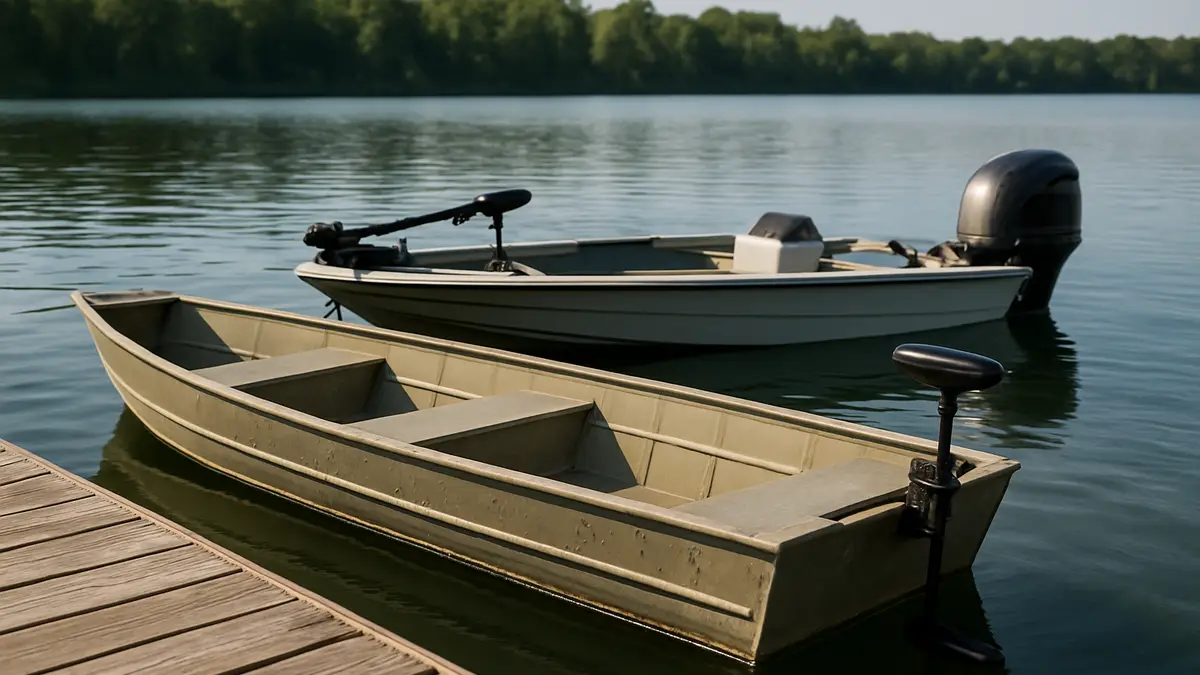
A trolling motor is a quiet electric motor that moves a fishing boat at low speed without the outboard. It mounts either on the bow, where it pulls the boat from the front, or on the transom, where it clamps to the stern and pushes. The mount you choose decides how you steer, where you stand to fish, how much you spend and how hard installation is.
Bow mount or transom mount: which should you buy?
Choose a transom mount for a small tiller boat steered from the back, and a bow mount if you fish standing at the front or in wind. The difference shows up in control more than in power.
| Transom mount | Bow mount | |
|---|---|---|
| Where it sits | Clamped to the stern | Bolted to the front deck |
| How it moves the boat | Pushes | Pulls, so the bow follows the motor |
| Steering | Hand tiller | Hand, foot pedal, wireless remote or GPS |
| Tracking in wind | Bow swings downwind | Holds a line well |
| Installation | Clamps on, no drilling | Bolted mount, wiring run to the bow |
| Typical price (Oct 2026) | $170-$430 | $550-$4,300 |
| Best for | Jon boats, small tiller boats, budgets | Bass, multi-species and bay boats |
A bow mount pulling from the front keeps the boat pointing where you want, which matters when you are casting to a bank in a crosswind. A transom mount works well when the angler sits at the back with one hand on the tiller anyway.
What size trolling motor do you need for your boat?
Minn Kota’s guidance is at least 2 lb of thrust per 100 lb of fully loaded boat weight, then more for wind and current. Loaded weight means hull, outboard, fuel, people, gear and batteries.
| Loaded boat weight | Calm water | Moderate wind or current (x1.25) | Strong wind, tide or river (x1.5) |
|---|---|---|---|
| 1,000 lb | 30 lb, 12 V | 30 lb, 12 V | 30 lb, 12 V |
| 1,500 lb | 30 lb, 12 V | 40 lb, 12 V | 45 lb, 12 V |
| 2,000 lb | 40 lb, 12 V | 55 lb, 12 V | 70 lb, 24 V |
| 2,500 lb | 55 lb, 12 V | 70 lb, 24 V | 80 lb, 24 V |
| 3,000 lb | 70 lb, 24 V | 80 lb, 24 V | 101 lb, 36 V |
| 3,500 lb | 70 lb, 24 V | 101 lb, 36 V | 112 lb, 36 V |
Minimum thrust rounded up to the next Minn Kota class. The wind multipliers are our heuristic, not a manufacturer figure.
Thrust classes map to voltage: 12 V up to 55 lb, 24 V for 70 to 80 lb, 36 V for 101 to 112 lb. Each step up adds a battery, covered in 12 vs 24 vs 36 volt trolling motors. The System Planner runs this for your exact weights and adds batteries, wire and breaker.
Which mount is best for a jon boat?
For most 12 to 14 ft jon boats, a transom mount in the 30 to 55 lb range is the better first motor. A loaded 14 ft jon boat with two anglers often weighs 700 to 1,000 lb, which needs only 14 to 20 lb of thrust by Minn Kota’s rule, so a 30 or 40 lb motor has reserve for wind.
The transom mount clamps on without drilling and leaves the bow free. Its limits: the transom may already carry the outboard, and steering from the back means you fish from the back.
A bow mount on a jon boat makes sense once you fish standing in the front, especially on rivers or windy lakes. Most jon boats need a flat mounting surface first: a deck plate bolted through the bow seat or a front casting deck. Quick-release brackets such as Minn Kota’s MKA-21 ($104.99 at West Marine, October 2026) let you remove the motor between trips. Placement, through-bolting and first-run checks are covered in how to mount a bow trolling motor.
How long should the trolling motor shaft be?
Long enough that the propeller stays fully submerged in the waves you fish, measured from the mount to the waterline. Too short a shaft lets the prop break the surface and cavitate; too long drags in shallow water and is awkward to stow.
Garmin publishes the clearest chart for its Force motors (bow-to-waterline distance, measured in calm conditions):
| Motor | Bow-to-waterline distance and recommended shaft |
|---|---|
| Garmin Force, Force Pro | 0-19 in: 50 in shaft; 15-26 in: 57 in shaft |
| Garmin Force Kraken | 0-19 in: 48 in; 15-34 in: 63 in; 26-46 in: 75 in; 38-61 in: 90 in; 53-81 in: 110 in |
Garmin’s two rules apply to any brand: where large waves are common, add 8 inches to your measurement, and if you fall in an overlapping range, pick the longer shaft. Small transom motors come in shorter shafts; the Minn Kota Endura C2 is sold with 30, 36 and 42 inch shafts. Take the longer option if your transom sits high or you fish choppy water.
How do you steer each type: hand, foot or remote?
Transom mounts steer by hand tiller; bow mounts add foot pedals, wireless remotes and GPS control. The control style matters more than the mount for how a day on the water feels.
- Hand tiller: the Endura C2 has five forward and three reverse speeds and a 6-inch telescoping tiller. Simple, cheap, reliable.
- Hand-steered bow mount: the Minn Kota Edge. You lean over the bow to steer, which is fine for occasional use.
- Cable foot pedal: the Minn Kota Fortrex steers through a cable from a pedal, leaving both hands for the rod.
- Wireless remote and electric steering: Terrova, Ultrex, MotorGuide Xi3 and Xi5, Garmin Force and Lowrance Recon steer from a remote or a wireless pedal.
- GPS positioning: Spot-Lock, Pinpoint and anchor lock hold the boat on a spot with no anchor; see spot-lock trolling motors compared.
Within Minn Kota’s own range, how the Terrova, Ultrex and Ulterra differ in steering and stowing is laid out in Terrova vs Ultrex vs Ulterra.
How much do bow and transom trolling motors cost?
Transom mounts cost $170 to $430; bow mounts run from $550 for hand control to over $4,000 for GPS models with built-in sonar. Prices checked on 2026-10-06:
| Model | Mount, control | Thrust, voltage | Price (Oct 2026) |
|---|---|---|---|
| Minn Kota Endura C2 | Transom, hand | 30 lb 12 V (30 in) to 50 lb 12 V (42 in) | $169.99-$289.99 |
| Minn Kota Riptide transom | Transom, hand, saltwater | Several thrust options | $319.99-$429.99 |
| Minn Kota Edge | Bow, hand | 45 lb 12 V to 70 lb 24 V | $549.99-$799.99 |
| Minn Kota Fortrex DSC | Bow, cable foot pedal, built-in CHIRP sonar | 80 lb 24 V, 112 lb 36 V | $1,699.99-$1,899.99 |
| Minn Kota Terrova | Bow, wireless, Spot-Lock | Several thrust and shaft options | $2,399.99-$3,799.99 |
| Minn Kota Ultrex CHIRP | Bow, cable foot pedal, Spot-Lock | 80 lb 24 V, 112 lb 36 V | $2,899.99-$3,199.99 |
| Lowrance Recon FW | Bow, wireless, GPS anchor, brushless | 24/36 V | $3,599.99-$3,699.99 |
| Garmin Force Kraken | Bow, wireless, anchor lock, brushless | 24/36 V | $3,999.99-$4,099.99 |
| Garmin Force Pro | Bow, wireless, anchor lock, brushless | 100 lb at 36 V | $4,199.99-$4,299.99 |
Endura C2, Edge, Fortrex, Ultrex, Recon and Force prices from Tackle Warehouse; Riptide transom and Terrova from West Marine; all 2026-10-06.
What else does a bow mount need?
A bow mount needs a wiring run to the front of the boat, a properly sized breaker, and often a second or third battery. That system cost is easy to miss when comparing motor prices.
A 55 lb, 12 V bow mount with a 15 ft run from the batteries needs 4 AWG wire and a 60 A breaker under Minn Kota’s sizing table; an 80 lb, 24 V motor at the same length needs 8 AWG and a 60 A breaker plus a second battery. Those numbers come from the trolling motor wiring guide, and the battery count and runtime from trolling motor battery sizing. A transom mount usually sits beside the battery with its own short leads.
Which situations need a different kind of motor?
Kayaks, canoes, pontoons, saltwater and boats above about 3,500 lb loaded each change the answer.
- Kayaks use short-shaft stern or bow motors with dedicated mounts; see kayak trolling motors.
- Canoes take a transom-style motor on a square stern or on a side-mount bracket; see canoe trolling motors.
- Pontoons need a long shaft for their high front deck and a mount clear of the tubes; see trolling motor for a pontoon boat.
- Salt or brackish water needs a motor built for it, such as Minn Kota’s Riptide line or Garmin’s saltwater-rated Force Kraken; see saltwater trolling motors.
- Heavier boats in strong wind can need more than the 112 lb, 36 V class; at that point, ask a dealer about the boat’s rigging.
Who is this comparison not for?
This page helps small-boat anglers choose a mount and thrust class; it is not an installation manual. Follow the motor’s installation instructions for mounting hardware and torque, and Minn Kota’s own advice to have a qualified marine technician alter boat wiring, following ABYC standards.
We did not test these motors on the water. Specs come from the manufacturers and the retailer listings named, and the thrust table applies Minn Kota’s published rule plus our labeled wind multipliers.
Frequently asked questions
Quick answers to what anglers ask us most
Is a bow mount or transom mount trolling motor better?
Neither in general. A bow mount pulls the boat, so it tracks and holds a line better in wind and frees the front deck for fishing. A transom mount is cheaper, simpler and suits small tiller boats steered from the back.
Can you put a bow mount trolling motor on a jon boat?
Yes, if the bow has a flat, solid area for the mount, often a plywood or aluminum deck plate bolted through. Many jon boat owners start with a transom mount because it clamps on with no drilling.
What size trolling motor do I need?
Minn Kota's guidance is at least 2 lb of thrust per 100 lb of fully loaded boat weight. A 1,500 lb loaded boat needs 30 lb in calm water; in regular wind or current, size up one or two classes.
How long should a trolling motor shaft be?
Measure from the mount to the waterline and use the maker's chart. Garmin's Force chart puts a 0-19 inch bow height on a 50 inch shaft. In big waves add 8 inches; between sizes, take the longer shaft.
How much does a bow mount trolling motor cost?
In October 2026, a hand-steered Minn Kota Edge cost $549.99 to $799.99, a foot-pedal Fortrex $1,699.99 to $1,899.99, and GPS motors with Spot-Lock or anchor lock about $2,400 to $4,300.